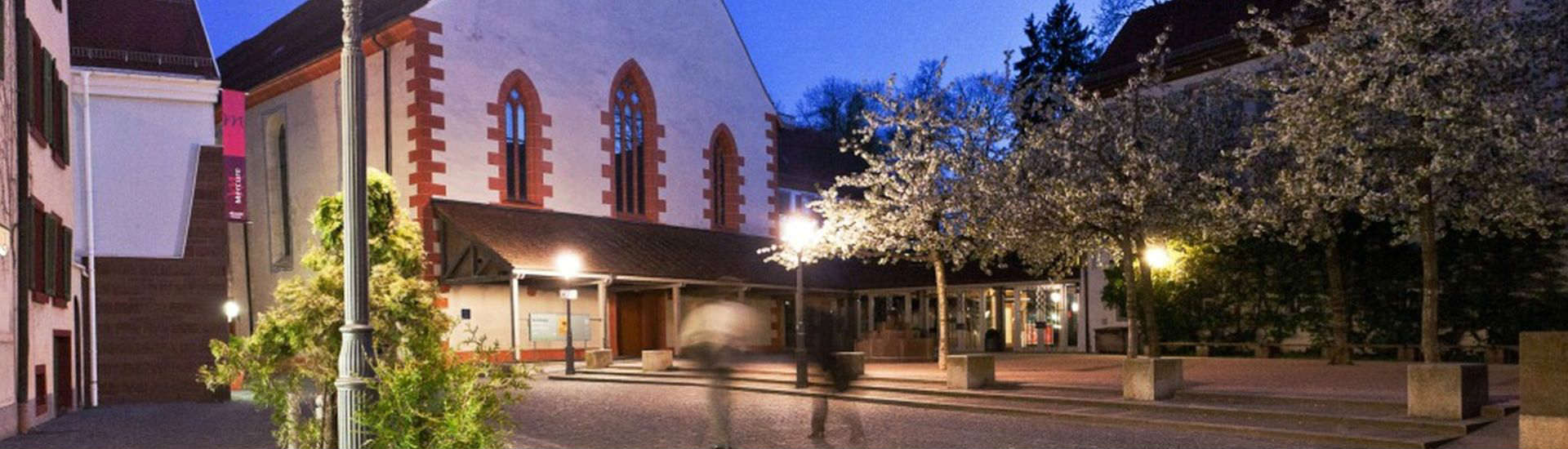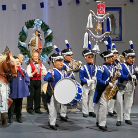
Even during the “high days” of Carnival, visitors have the opportunity to see the special exhibition “Key Handover: The Figures of Ingeborg Jaag.” The popular Carnival figures, in doll size, can be seen there during the key handover at Villingen City Hall and during the parade at the Upper Gate. As part of the special exhibition and the permanent exhibition on the history of Villingen Carnival, the Franziskanermuseum is offering special opening hours this year on Carnival Monday and Carnival Tuesday, from 1:00 p.m. to 5:00 p.m. each day. The Franziskanermuseum will be closed only on Thursday, February 28.
The café at the Franziskanermuseum will also be open during Carnival and will be transformed into a traditional “Stüble”: on Thursday, Sunday, and Tuesday starting at 2 p.m., and on Carnival Monday as early as 7 a.m.
Following the rescue of the cat “Miau” from the Romäus Tower and just before the handover of the keys at City Hall, this Carnival tour offers an entertaining look at the history and stories behind the key figures of the “fifth season.” Gunther Schwarz will not only refresh visitors’ knowledge of Carnival but also get them into a festive mood with his singing. The tour will also include a visit to the special exhibition “Key Handover: The Figures of Ingeborg Jaag.”
Tickets for the tour are available on Sunday, March 3, at the museum ticket office.

Dr. Sabine Dietzig-Schicht takes visitors on a folklore-themed spring walk through the Franciscan Museum. Using selected objects in the city history section and the Black Forest collection, the cultural studies scholar explains old and new Black Forest customs associated with this time of year. In addition to farmers’ weather proverbs, the tour will also explore the religious festivals of this time of year, such as Easter, which is considered the “Festival of Festivals” in the Christian calendar.
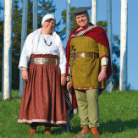
For the fourth Celtic Day, the Franziskaner Museum welcomes the living history group Carnyx from Rottenburg am Neckar, which specializes in experimental historical reenactments of the Celtic era. At their encampment in the Franziskaner’s courtyard, visitors can experience prehistory firsthand: on display are the equipment and weapons of Celtic warriors, as well as the traditional clothing and jewelry worn by women of that era. The event also features craft demonstrations, hands-on activities, and guided tours of the Magdalenenberg exhibition. Other guests include ceramic artist Bettina Kocak (Goldgrubenkeramik) and the Baden-Württemberg State Archaeological Museum in Konstanz.
The Café im Franziskaner will provide refreshments, including mead and suckling pig. The Friends of the Municipal Museums in Villingen-Schwenningen e.V. is a partner in this event.
Admission is free!
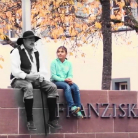
The museum’s motto, “See for Real—Encounter for Real,” was transformed by filmmaker Christoph Brach into a short film with an imaginative narrative framework. Through the encounter between a girl and a mysterious stranger, the film takes viewers on a journey through the Franciscan Museum and its diverse collections—from the Celtic princely tomb at Magdalenenberg to the City History section and the Black Forest Collection. The approximately 8-minute film portrays the museum as a place of wonder and discovery, but also—in keeping with the motto—as a place of encounter, such as at the annual museum festival.
With this new short film, the museum continues the path of digitization it has been pursuing in recent years through its blog and museum app. The film is now available on the Franziskanermuseum’s website and on the city’s YouTube channel:
https://www.franziskanermuseum.de/impressionen/imagefilm.html
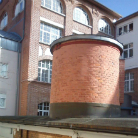
On this family tour, Yannick Philipzig explains the history of alarm clocks and cuckoo clocks in a fun and engaging way. Throughout the museum, scavenger hunts reveal what used to characterize a factory and where animals are hidden throughout the museum. Another highlight is the “Living Cuckoo Clock” game.
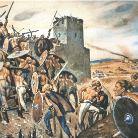
Conceived by the Alamanni Museum in Vörstetten, this exhibition explores the concept of the Alamanni through the ages. First mentioned in Roman sources in the year 289 AD, the name “Alamanni” originally referred to Germanic tribes that settled in the areas abandoned by the Romans after the fall of the Limes. Over the course of history, the term underwent multiple shifts in meaning. The National Socialists reinterpreted it in “ethnic” terms, a misappropriation that reached its peak in Nazi racial ideology. Directly following this, Rudolf Ströbel established the Alamanni and Roman Rooms at the Schwenningen Local History Museum in 1950. The exhibition thus also sheds light on a chapter in the history of the Schwenningen Museum.
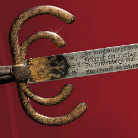
The Friends of the Municipal Museums in Villingen-Schwenningen e.V. invites museum enthusiasts to an excursion to the Württemberg State Museum in the Old Palace in Stuttgart. The museum is presenting the comprehensive exhibition “The Fascination of Swords.” On display are more than 340 unique objects, including world-famous swords and 3,600-year-old originals. Visitors will also see works of art, manuscripts, and Hollywood posters that explore the “Fascination with Swords.” The group will be guided by Thomas Hoppe, M.A., one of the exhibition’s curators. Guests and non-members are also warmly welcome. The cost for the bus ride, admission, and guided tour is 26 euros. Departure is at 8:30 a.m. from Villingen; arrival is scheduled for approximately 6:00 p.m.
Registration is available through the chairman of the Friends’ Association, Wolfgang Heitner, at 07721/27721 or freundeskreis.museen.vs@web.de.