The educational programs offered by the City Museums cover a wide range of topics. Preschoolers immerse themselves in past eras, actively acquire and deepen their knowledge, or learn about the latest research and specific information related to the themes of the permanent exhibitions through special exhibitions. Each target group receives tailored programs that combine educational content with hands-on exploration.
Max. 19 children per group; groups of 20 or more will be divided into 2 groups
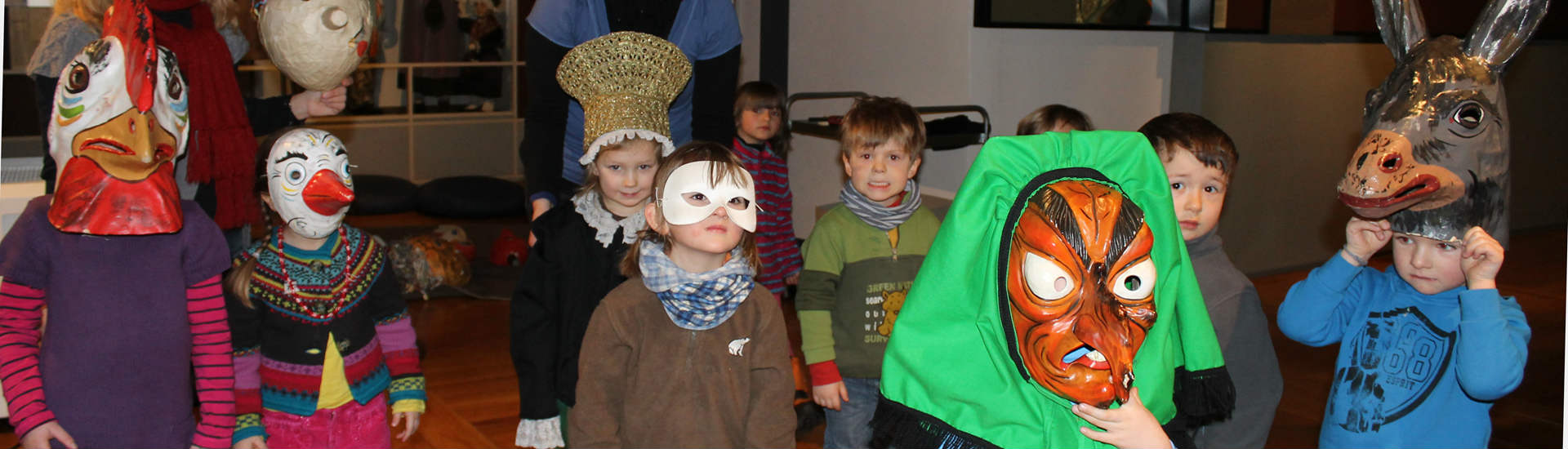
The figures depict the world of Villingen’s Carnival in miniature (1:3 scale). At the center is the parade of the historic Narrozunft, featuring Narro and Alt-Villingerin, Stachi and Morbili, Treiber, Butzesel, and Wuescht. Among the spectators are well-known local figures and “characters” such as the Eiermaa and the Spittelmatthis. Every year, new figures and scenes are created based on a special theme. The children discover the individual figures for themselves with the help of picture cards. Afterward, the children make stick puppets.
Connection to the curriculum: Preschool, elementary schools up to 2nd grade
At its core, Carnival is a festival that precedes Lent: people indulged one last time in all the carnal pleasures that would be forbidden in the days to come. The figure of the fool serves as a sinful counterpoint to the devout believer, but at the same time as a seductive reflection of one’s own longings and vanities. During the guided tour, the background of the tradition as well as individual motifs—such as the foxtail and collar, the donkey’s head, and straw—are explained in an age-appropriate manner against a general cultural and intellectual-historical backdrop. Afterward, participants will make stick puppets.
Relation to the curriculum: Preschool, all grade levels
Age: 5 to 99 years
Duration: 60 minutes
In the museum’s permanent exhibition, children go on a hunt for Easter eggs and, along the way, learn what Easter is actually about and how Easter traditions have evolved.
Afterward, there’s a short craft activity where they make egg cups. Depending on your preference, we can place greater emphasis on the Christian background of Easter or on the playful aspect.
We also offer a themed tour without a religious focus, featuring a museum scavenger hunt through the Black Forest collection.
Relevance to the curriculum: Preschool, grades
1–4 Age: 5 to 12 years
Duration: Preschool 60 minutes
Many people associate the Middle Ages with wars, epidemics, and hardship. But what was life like for children back then? This program aims to show that people enjoyed playing games in every era. It explores and explains the similarities and differences between medieval and modern games. We’ll also highlight the differences in the social roles of children back then compared to today. By comparing these with their own lives, participants can deepen their understanding of the Middle Ages.
If the weather is nice: games in the courtyard, such as tug-of-war, the egg race, and sack races.
Relation to the curriculum: Preschool, grades
1–4 Age: 5 to 10 years
Duration: 60 minutes
The Magdalenenberg princely tomb, dating from around 616 B.C., is considered the largest Iron Age burial mound in Central Europe. The leader of a local early Celtic community—a so-called “prince”—was buried there in a chariot grave. During the guided tour for kindergartens and elementary schools, the children search for grave goods themselves in a sandbox featuring a true-to-scale reconstruction of the burial chamber. As a hands-on activity, participants work in small groups to create clay pots and jewelry.
Relevance to the curriculum: Preschool, grades
1–4; Age: 5 and
up; Duration: 60 minutes
The rural past of the Black Forest is often romanticized as the “good old days.” However, these idealized notions do not convey how people actually lived and went about their daily lives. This guided tour offers a general introduction to life in the Black Forest 100 to 200 years ago and covers topics such as glassmaking, the clock trade, and the traditional costumes of that era.
In small groups, participants will try on an original Sankt Georgen traditional costume and other traditional costumes, examining their individual components, and decorate wooden boxes.
Relevance to the curriculum: Preschool, all grade levels
Age: 5 to 99 years
Duration: 60 minutes
The cuckoo clock is regarded worldwide as a symbol of the Black Forest. However, it is less well known how the bird—which, as is well known, lays its eggs in other birds’ nests—came to be featured in the clock. Questions like these are answered during the guided tour. The tour explores both the cuckoo’s role as a harbinger of spring and a symbol of good luck, as well as the evolution from the cuckoo flute to the bellows-powered flute and from the lacquered shield clock with a painted bird to the cuckoo clock. Participants will make a miniature cuckoo clock out of a matchbox.
Relevance to the curriculum: Preschool, grades
1–4 Age: 5 to 10 years
Duration: 60 minutes
At the Franciscan Museum, children can immerse themselves in the true history of Christmas—without Santa Claus or a Christmas tree, but surrounded by original works of art. During the popular Christmas tour, children explore Christmas traditions in a playful way and learn not only what myrrh and frankincense are, but also that St. Nicholas came from Turkey. In front of a valuable late-medieval tapestry depicting the Nativity, they can even act out a nativity scene themselves.
Age: 5 and
up Duration: 60–90 minutes
Prices and Group Registration
€1 per child, plus material costs
Click here to register your group using the online booking form