by Christian Seitz, M.A., Heidelberg
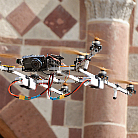
Digital methods have radically expanded the possibilities of archaeology. Whereas brushes, shovels, and pencils once defined the image of an excavation, techniques such as photogrammetry and 3D scanning have long since become standard. Archaeologist and geoinformatics specialist Christian Seitz will demonstrate how spatial information can be extracted from image series and how drones can be used to document archaeological monuments.
The event is being held in cooperation with the German Foundation for Monument Protection, Villingen-Schwenningen Local Board.
Admission is free.
Costume-themed tour with Henry Greif
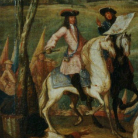
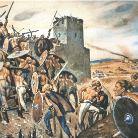
Time and again, the small town of Villingen had to fend off severe sieges. The town was hit particularly hard during the Thirty Years’ War in the 17th century. A Villingen citizen from that era uses original artifacts to recount how he experienced the fighting, how the people of Villingen defended themselves, and why luck sometimes played a greater role than heroism.
with Natalie Leva
The Easter Bunny has hidden his eggs in the courtyard of the Franziskaner. After the Easter egg hunt, selected museum objects will be used to explain, in a child-friendly way, what Easter is actually about and how Easter traditions have evolved.
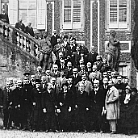
The years 2018 and 2019 mark the anniversaries of important events in Baden’s history: In 1818, the Grand Duchy of Baden adopted a constitution that was groundbreaking for its time and considered an early example of a constitutional government. During the 1918 revolution, the monarchy collapsed, and Baden became a republic, which in 1919 adopted one of the most democratic constitutions of the time. In this exhibition, the General State Archives in Karlsruhe explores these pivotal turning points in Baden’s history. Drawing on a wealth of significant and previously unknown documents and exhibits, the exhibition traces Baden’s path from monarchy to republic. In this context, it also sheds light on the revolutionary events
of 1848–49 in Villingen and Donaueschingen.
Exhibition dates: April 27 through June 9, 2019
. Admission is free.
> More about the exhibition’s accompanying program
with Ingeborg Kottmann, M.A.
This special exhibition on the history of democracy at the Baden-Württemberg State Archives explores the topic from various perspectives: It chronicles key events while also offering regional and biographical insights into the subject.
> More about the special exhibition
Last year, the Franciscan Museum was able to acquire a painting by Waldemar Flaig (1892–1932). It is a portrait of Dr. Gustav Naumer, dated 1931. Naumer, born in Neustadt an der Weinstraße, was an ear, nose, and throat doctor in Villingen.
In her new blog post, Dr. Anita Auer describes the special relationship between the artist and the subject of the portrait. Fortunately, the subject’s son was able to share with the museum what he knew about the circumstances surrounding the portrait’s creation and its use as a form of payment.
More blog posts are available at www.stadthochzwei.de
Through June 30, 2019
with Dr. Michael Hütt
, Sunday, April 7, 3:00 p.m.
The combined tour begins at the Local History and Clock Museum and ends at the Clock Industry Museum.
with Dr. Michael Hütt
Thursday, April 11, 6:00 p.m.
with Dr. Michael Hütt
Sunday, April 28, 3:00 p.m.